Servers turn almost every watt of power they use into heat. If the cooling stops, a data hall can overheat in minutes, so the cooling system is just as critical as the power system. When data centers are described as Tier III or Tier IV, the Tier level affects how the cooling is designed too. This post explains the difference in simple terms.
A quick note on the Tier system
The Tier classification comes from the Uptime Institute, in its Tier Standard: Topology. It defines four levels, Tier I to Tier IV, based on how well a data center's infrastructure can keep running during maintenance and failures. Tier is judged on the whole site: power, cooling, and other systems. A site's Tier level is only as high as its weakest system, so a Tier IV power design with a Tier III cooling design is a Tier III site.
Tier III cooling: concurrently maintainable
The key idea in Tier III is concurrent maintainability. Any cooling component, such as a chiller, pump, valve, or section of pipe, can be shut down for planned maintenance or replacement without turning off the IT equipment.
To make this possible, a typical Tier III cooling design has:
- N+1 redundancy: one extra chiller, pump, or cooling unit beyond what the load needs, so one can be taken out of service while the rest carry the load.
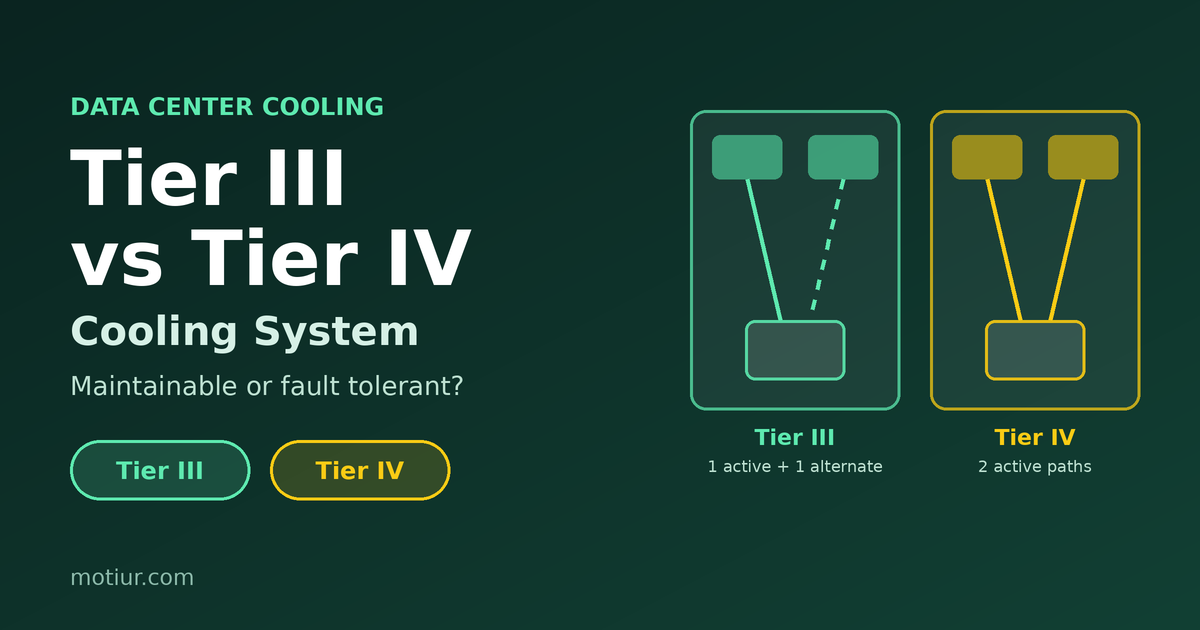
- Multiple distribution paths: usually one active path and one alternate path, with valves that let engineers isolate any section of pipework.
- Extra care with controls: the building management system (BMS) must also allow maintenance without risk to cooling.
The weak point is that Tier III protects against planned work. It is not designed to ride through every unexpected failure, such as a pipe burst, in the active path.
Tier IV cooling: fault tolerant
Tier IV includes everything in Tier III and adds fault tolerance. The cooling system can survive any single unplanned failure of a component or a distribution path without affecting the IT equipment. It can also be maintained without shutdown.
A typical Tier IV cooling design has:
- Higher redundancy: often 2N or 2(N+1), meaning a full second system, sometimes with spare capacity on each side.
- Two active, independent paths: if one path fails, the other keeps cooling with no switch-over delay.
- Compartmentalization: the two systems are physically separated, for example in different rooms or fire zones, so one event such as a fire or leak cannot damage both.
- Continuous cooling: heat removal must carry on during a power interruption, often with chilled water storage tanks or similar ride-through, and with fans and pumps on backed-up power.
- Fault-tolerant controls: sensors, controllers, and network connections are duplicated so that a single control failure does not stop cooling.
- Automatic response: systems react to faults by themselves instead of relying on an operator to act in time.
Tier III vs Tier IV cooling side by side
| Tier III | Tier IV | |
|---|---|---|
| Main idea | Concurrently maintainable | Fault tolerant |
| Planned maintenance without downtime | Yes | Yes |
| Survives a single unplanned failure | Not guaranteed | Yes |
| Typical redundancy | N+1 | 2N or 2(N+1) |
| Distribution paths | One active, one alternate | Two active, independent |
| Physical separation of systems | Not required | Required (compartmentalization) |
| Continuous cooling | Depends on the load density | Required |
| Commonly quoted availability | About 99.982% | About 99.995% |
| Cost and complexity | Lower | Higher, with more equipment, space, and controls |
The availability figures are often quoted online, but they are not part of the official standard, so use them only as a rough guide.
What this means in practice
- Equipment count: Tier IV can need nearly double the chillers, pumps, pipework, and controls compared to a Tier III design for the same load.
- Space: more equipment, plus physical separation, means a bigger plant area.
- Energy use: extra systems can run at low load, which may reduce efficiency unless the design handles it well.
- Operations: a Tier IV site needs skilled staff and strict procedures, because even the best design can be undone by human error.
Which one should you choose?
- Tier III suits most businesses, colocation, and cloud services. It gives strong protection and lets you maintain systems without downtime at a more reasonable cost.
- Tier IV suits operations where even a short outage causes serious harm, such as major financial systems, critical national services, or very high-value workloads.
Ask a simple question first: what does one hour of downtime cost us? If the answer is modest, the extra investment in Tier IV may not be justified. If it is very high, fault tolerance may pay for itself.
Common misunderstandings
- "Tier IV is always better." It is more resilient, but also more expensive and complex. The best design is the one that fits the business need.
- "N+1 means Tier III." Redundancy alone does not give a Tier level. The distribution paths, controls, and the ability to maintain everything without shutdown matter too.
- "Designed to Tier III" equals "Tier III certified". Certification is a formal review by Uptime Institute. Many sites are designed to a Tier level without being certified.
- "Cooling can be an afterthought." Even a perfect power system fails the Tier test if the cooling cannot keep running.
Tier III lets you maintain your cooling without stopping the data center. Tier IV lets your cooling survive a failure without stopping the data center.
Requirements are detailed and are updated from time to time, so always check the current Uptime Institute documents for the exact rules. If you are planning a new facility or an upgrade and want help choosing between Tier III and Tier IV for your cooling design, feel free to get in touch.